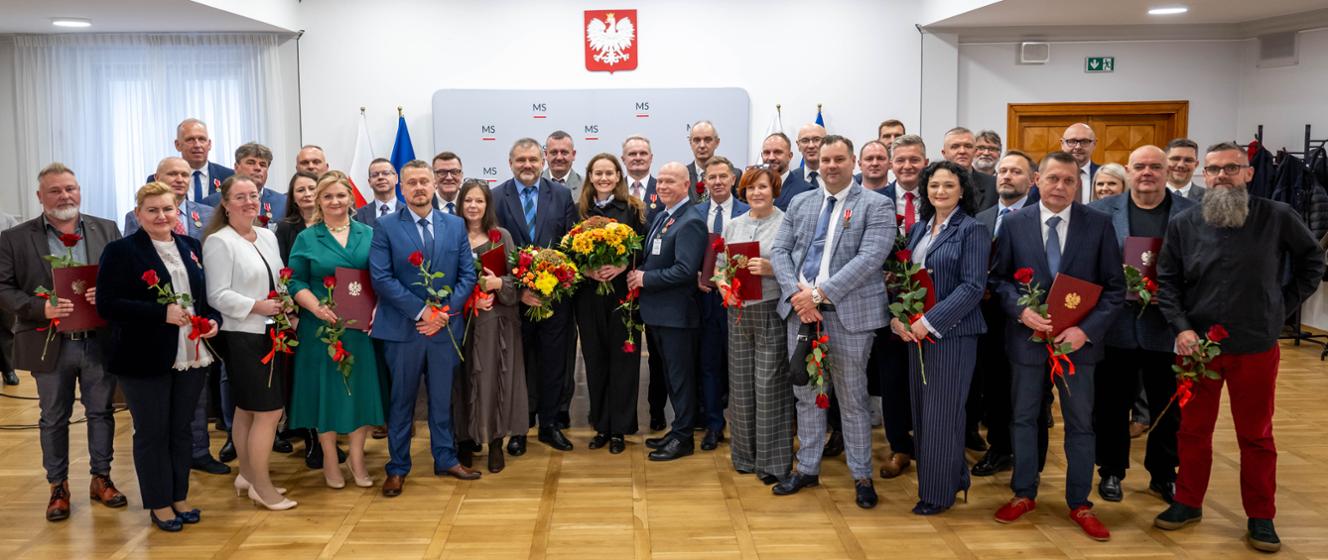
On 26 October 2026, on the occasion of National Education Day, a ceremony was held at the Ministry of Justice to award state honors. Minister of Justice Waldemar Żurek and Deputy Minister of Justice Maria Ejchart honored the staff of resocialization facilities who work daily with youth requiring special support. The ceremony aimed to recognize the commitment, professionalism, and daily work of pedagogues, educators, and teachers in the process of educating, raising, and resocializing young people.
A total of 32 people were honored during the ceremony. The awards included two main types of decorations: the National Education Committee Medals and the Minister of Justice Awards. The medals, which are granted by the Minister of Education, were awarded to 11 people for special merits in the development of education, upbringing, and youth support. Meanwhile, 21 employees received the Minister of Justice Awards, granted for outstanding achievements in shaping legal and civic awareness as well as for actions in favor of upbringing in the spirit of justice.
The recipients of the honors were employees of district educational centers, corrective facilities, and shelters for juveniles. The group of honorees came from facilities located in various parts of Poland, including, among others, Warsaw-Falenica, Dominowo, Gacki, Zawiercie, and Tarnów.
In his speech, Minister Waldemar Żurek emphasized how exceptional and difficult the work of those employed in facilities for juveniles is. He noted that the youth under their care often require extraordinary patience and understanding. The head of the Ministry of Justice stated that given the significant impact these staff members have on a young person's life and their chance to find their own path, they deserve “double medals and double honors.” He thanked them for taking on this difficult task and not remaining indifferent to the fate of those in their care.
Deputy Minister Maria Ejchart drew attention to the multifaceted role of employees in resocialization facilities. As she pointed out, their role goes far beyond a typical educational one, as the beneficiaries often reside at the facility daily rather than at home. They serve as role models for youth, showing them how to behave and how to view the world. The Deputy Minister emphasized that thanks to the work of these specialists, young people have the chance to gain a profession, pass their final exams, and build an honest life. She also underlined that the experience and length of service of the honorees are extremely important and serve as a model for future teachers, which is why the ministry is particularly concerned with retaining such staff.
Among the recipients of the National Education Committee Medal were, among others: Krzysztof Bartnicki (District Educational Center in Warsaw-Falenica), Jakub Gołota (District Educational Center in Witków), Sławomir Gruszczyński (Shelter for Juveniles in Dominowo), Anna Gwóźdź (Corrective Facility and Shelter for Juveniles in Zawiercie), Andrzej Jucewicz (Shelter for Juveniles in Dominowo), Mariusz Kulig (Corrective Facility in Tarnów), Tomasz Matyjas (District Educational Center in Gacki), Arkadiusz Rykała (Corrective Facility and Shelter for Juveniles in Zawiercie), Waldemar Waśkowicz (Shelter for Juveniles in Dominowo), Justyna Wójcik-Milewska (Corrective Facility and Shelter for Juveniles in Zawiercie), and Tomasz Zasada (District Educational Center in Warsaw-Falenica).
Meanwhile, the Minister of Justice Award was granted to, among others: Magdalena Bloch-Kaczka, Marcin Chiciak, Marian Chudziński, Michał Czerwiński, Zenon Czyżewski, Andrzej Dobrowolski, Andrzej Draheim, Rafał Dubiniak, Jacek Goworek, Justyna Kaczmarczyk, Marek Łukasiewicz, Tomasz Matyjas, Irena Mysakowska, Paweł Niewodowski, Marcin Sadowski, Karolina Skrzypek, Marzena Słaboń, Marek Sobura, Łukasz Subkowski, Andrzej Tomczyk, and Paulina Trzaska. All honorees held various positions, ranging from directors and school principals to teachers and educators, as well as pedagogues, psychologists, and addiction therapists.