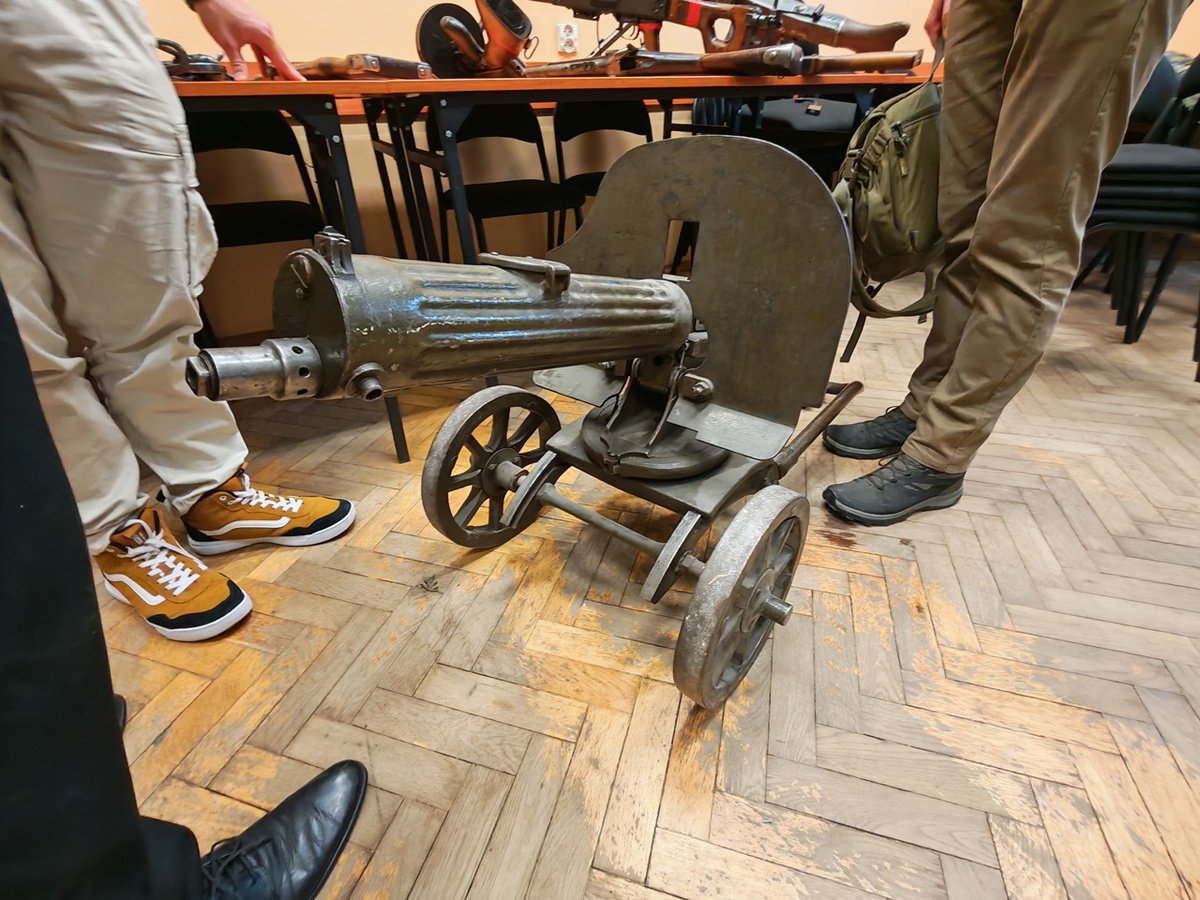
On October 28, 2026, a conference commemorating the centenary of firearms and ballistics research in the Polish Police was held at the Faculty of Mechanical and Manufacturing Engineering of the Warsaw University of Technology. The event, organized by the Police Central Criminalistics Laboratory (CLKP), brought together representatives of the scientific community, officers, and experts responsible for the development of this specialization. Participants discussed both the historical roots of police ballistics forensics and the contemporary applications of advanced research techniques.
Origins of the Specialization
The symbolic beginning of this decade-long tradition of research is attributed to events at the turn of the 20s and 30s of the 20th century. A key moment was the murder committed with a firearm on December 27, 1926. The identification analysis of casings related to this case led to the issuance on January 4, 1927, of the first expert opinion in the field of firearms and ballistics research. This was done by Józef Piątkiewicz. The historical context for the development of this field was the separation of the Criminalistics Laboratory of the Headquarters of the State Police from the Main Police School, which took place in October 1927.
Modern Capabilities and Resources
Contemporary ballistics research goes far beyond simply determining caliber or the type of weapon. Currently, 29 experts with the authority to issue opinions are actively working, employed in 12 Police criminalistics laboratories. According to archival data, since 1957, the qualifications of 48 subsequent experts have expired, while nine candidates are still developing their specialization.
In the work of experts, criminalistics collections play a key role. The Firearms Reference Collection, one of the fundamental tools for identification, currently numbers over 3,000 items. Experts also use the National Collections of Casings and Bullets, modern optical equipment, and automatic weapon identification systems. The scope of analyses includes, among others, ammunition examination, propulsion devices (including homemade constructions), analysis of gunshot wounds, and external ballistics research.
Anniversary Honors
An important element of the conference was the ceremony honoring individuals who, over the years, have contributed to the development of this field. Commemorative statues were presented to retired heads, supervisors, and experts. The honorees included, among others, Jarosław Rosiak, Krzysztof Ćwik, Andrzej Matkowski, Paweł Denys, Krzysztof Snopkowski, Piotr Mazur, Robert Sikora, Andrzej Królik, Wojciech Grojec, and Krzysztof Baran. The honors were presented by Deputy Chief of the Polish Police Senior Inspector Dr. Tomasz Michułka and Director of CLKP Inspector Iwona Marciniak-Krawczyk.
Active experts who are still in service were also honored. The list of honorees included, among others, Jarosław Dyga, Grzegorz Bogiel, Paweł Dudek, Piotr Jezierski, Artur Grabarczyk, Krzysztof Zdeb, Stanisław Gogojewicz, Maciej Kuliczkowski, Mariusz Skroban, Tomasz Walczak, Bartłomiej Zep, and Robert Arciszewski. The Director of CLKP emphasized that the anniversary is primarily a celebration of the people whose knowledge and commitment determine the quality of criminalistic opinions.
Shooting Competitions
The celebrations marking the centenary of ballistics research also included a sports component. On September 3, 2026, the shooting competitions for the CLKP Director's Cup were held. The competition took place in two events: precision shooting at a distance of 25 meters and rapid shooting at a distance of 15 meters. Teams representing the criminalistics laboratories of the voivodeship headquarters and the capital city headquarters entered the competition.
In the individual women's classification, Senior Inspector Małgorzata Galarda from CLKP won. Meanwhile, in the individual OPEN category, Senior Inspector Robert Mróz, also working at the Police Central Criminalistics Laboratory, triumphed. In the team classification, the CLKP team, comprising Paweł Adamowski, Małgorzata Galarda, and Robert Mróz, took first place. Teams from Kielce (second place) and Kraków (third place) also made the podium.
The choice of Warsaw University of Technology as the venue for the celebrations had symbolic significance. The university has cooperated with police laboratories for decades, and many of the current experts are its graduates. The event aimed not only to commemorate history but also to promote further scientific and practical cooperation between the academic environment and the Police.