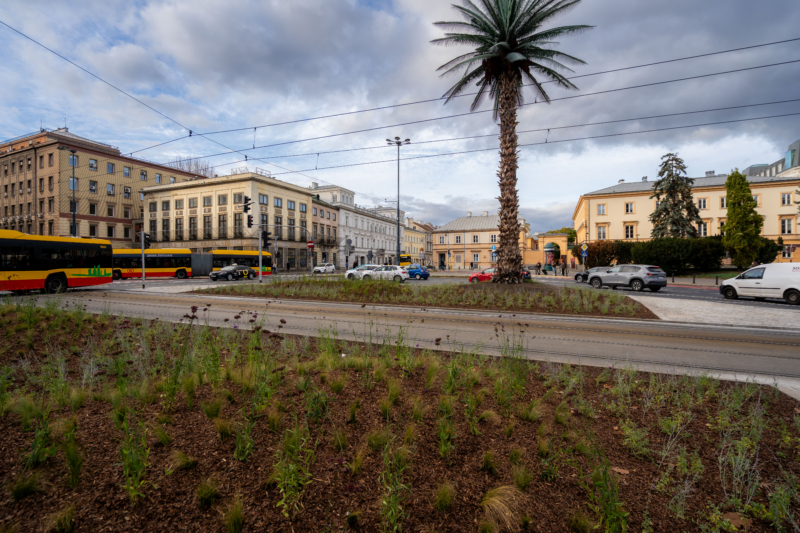
Significant works on the traffic layout and spatial arrangement of De Gaulle Roundabout in the Warsaw city centre have been completed. The project involved breaking up and removing approximately 500 m² of unnecessary concrete pavement and replacing it with green space. These changes aim to transform a location that, for years, was characterised by concrete dominance into an environmentally and user-friendly space, while preserving the roundabout's characteristic feature – the palm tree.
The greenery design project was created in collaboration with Joanna Rajkowska, the artist who has been the author of the palm decorating the roundabout for nearly 24 years. According to the contractors, the concept was intended to reference the tropical character of the growing plant, creating a composition mimicking islands surrounded by the ocean. After removing the old asphalt and concrete, artificial terrain mounds were outlined and then planted with selected species. The planted plants included, among others, gladiolus, verbena, catnip, and sage.
The total number of installed plants is 7,000 perennials and bulb plants. The species selection was deliberate, aiming to achieve a colour effect resembling islands and the sea, although the full visual effect will only be assessable after the plants bloom in spring. These changes are part of a broader urban centre greenery strategy, where concrete is being gradually replaced by biogenic surfaces.
Context of the New Centre of Warsaw project
The actions taken at De Gaulle Roundabout fit within the framework of the New Centre of Warsaw project. The goal of this initiative is to transform the strict centre of the capital from a space primarily subordinated to motor vehicle traffic into a multifunctional area that is friendly to pedestrians, cyclists, and residents. Greening of streets and squares is one of the key assumptions of this program, which aims to improve the quality of life in the city.
In parallel with the work on the roundabout, similar actions were completed at the nearby Plac Trzech Krzyży (Three Crosses Square). In this location, the area was also unpaved, particularly in front of the Ministry of Development and Technology building. In total, 39 new trees were planted in the square during the recent investments, and 4,500 m² of new green space was created, replacing the previous concrete.
As officials emphasize, introducing greenery into dense urban development serves not only aesthetics. Tree-covered and shrub-covered areas function as a natural barrier limiting noise and dust levels from traffic. Greenery also promotes better water retention and helps mitigate the heat island effect, which translates into improved air quality and the well-being of residents on hot days.