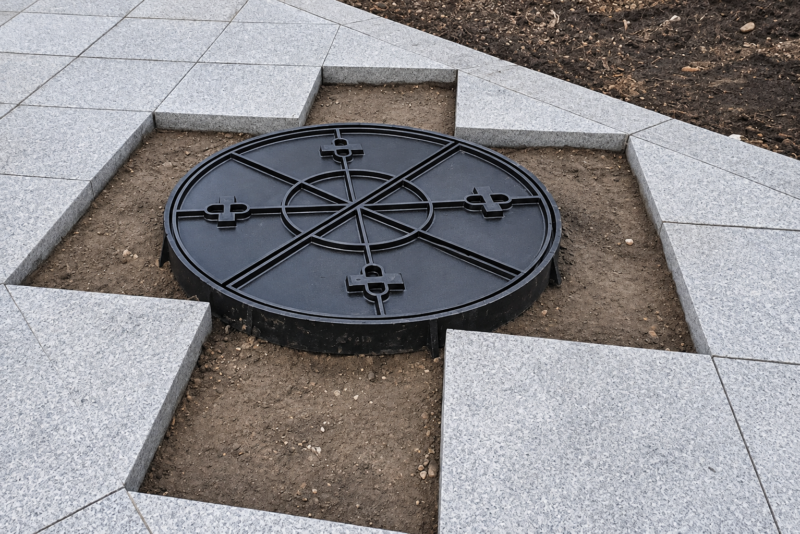
During construction works carried out in the vicinity of Sienkiewicza Street, near the intersection with Marszałkowska Street, a unique element of urban infrastructure from the turn of the 19th and 20th centuries was discovered. It is a historic entrance cover to an underground transformer station, estimated to date from around 1914. It was located as part of the redevelopment of the Złota/Zgoda block, within the New Warsaw Centre project.
The found object has impressive dimensions and weight. Its mass is 0.5 tons, its height exceeds 30 centimeters, and its width reaches 150 centimeters. Following an inspection by the Mazovian Voivodeship Conservator of Monuments, it was determined that the object was in surprisingly good condition. The only traces of the passage of time were minor damages and rust. The cover formerly led to a chamber, which turned out to be empty during the excavation works—old technical equipment had not survived, and the space had been filled with rubble due to successive transformations of this part of the city.
The History of Capital's Electrification
The discovery reminds us that the energy network of Warsaw, though it seems like a given today, has a relatively young history. The first plans for the city's electrification were drawn up in 1898, and their author was William Heerlein Lindley. The implementation of the project began at the beginning of the 20th century. In 1902, the city authorities granted a concession for the construction of a power plant, and a year later, in 1903, the Temporary Power Plant was launched on the Powiśle. The choice of this location was dictated by the desire to minimize network construction costs.
The next milestone was the launch of the Warsaw Power Plant at the end of 1904. This facility was built on a plot bounded by Wybrzeże Kościuszkowskie and Elektryczna, Dobra, and Leszczyńska streets. A historical curiosity is the fact that Warsaw received a central, city-wide power plant as the thirtieth city in Polish lands (excluding tramway power plants). In the later period, power plants on Mokotów and Wola also gained a strong position in the system, while the facility on Powiśle was constantly expanded.
Before the outbreak of World War I, access to electricity in the capital was not widespread and was rather a luxury for selected institutions and private individuals. The development of the network was hampered by the slow expansion of cable infrastructure and war damages. During the occupation, copper wires were additionally dismantled, which the occupant used in the war industry.
A New Chapter in Network Development
A real boom in the expansion of the electrical network occurred in the mid-1920s. A key moment was 1936, when the power plant's property came into the ownership of the city. Energy prices were also lowered at that time, which translated into increased consumption by customers. Simultaneously, a significant technical change was made: the network voltage was increased from 120 volts to 220 volts.
Further development was interrupted by World War II. The reconstruction of the destroyed network lasted until 1948, after which intensive expansion took place, which was the biggest development impulse in the history of the capital's energy sector. Warsaw power plants were connected to the national energy system, and all plants began to operate as combined heat and power plants, providing the city with not only electricity but also heat. By 1970, electricity had become so common that in Warsaw only 334 residential buildings, which accounted for 0.7 percent of the total, remained without access to electricity.
The Underground Heart of Infrastructure
Until the end of the last century, underground transformer stations played a key role in the network. Around 1933, there were 1,325 such stations and five 15/5 kV substations operating in Warsaw. These stations employed 1,373 dry transformers with a total capacity of 80,000 kVA. The 5 kV distribution network was divided into 43 closed zones, each serving from 20 to 40 stations.
Underground chambers, often of reinforced concrete construction, served as power supply points. They usually contained two transformers, high and low voltage boards, and automatic circuit breakers. However, access to these devices was often difficult, and their maintenance and repairs involved major complications. Moisture and atmospheric precipitation required the use of specialized ventilation systems, traces of which (grates) can still be found near some covers today. With technological progress and modernization of the distribution system, underground stations lost their functionality.
Decisions
- Decision to build a 15 kV network made in 1930.
- Decision to transition from 5 kV to 15 kV voltage made in 1936.