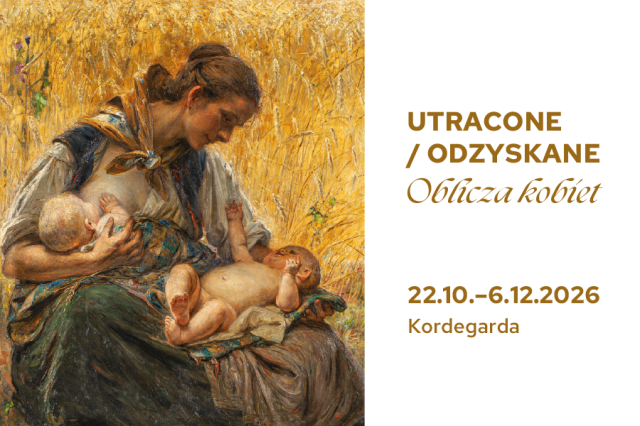
On October 21, 2026, the opening of the jubilee, tenth edition of the "Lost / Recovered" exhibition cycle will take place at the Kordegarda gallery in Warsaw, located at 15 Krakowskie Przedmieście Street. This year’s edition, titled "Faces of Women", is dedicated to images of women in art from the 17th to the 20th century. Admission to the exhibition is free.
Works that returned after decades
The organizers of the project are the Ministry of Culture and National Heritage and the National Cultural Centre. The main aim of the exhibition is to show the results of long-term restitution efforts that led to the return to Polish collections of objects that had been considered permanently lost for decades. As noted by the Minister of Culture and National Heritage, Marta Cienkowska, over 920 objects have been recovered so far, and more than 200 restitution cases are currently underway in 18 countries around the world. Each of these numbers corresponds to a specific work of art that returned to the country thanks to the work of experts and the determination of institutions.
On a regular basis, the objects presented in the exhibition are part of the collections of key Polish museums, including Wawel Castle, the Wilanów Palace, the Ossolineum in Wrocław, and the National Museums in Warsaw and Wrocław. Their joint assembly in one place provides a rare opportunity to see works of the highest museum class and to learn about the history of the people who contributed to their return.
Portraits and scenes from history
The exhibition covers a wide thematic range: from portraits of aristocrats, to depictions of mothers and children, saints, and allegories, to scenes showing women in everyday roles. Among the key items is a 17th-century "Madonna with Child" by Alessandro Turchi (or attributed to him by researchers). The painting was taken from the Lubomirski Palace in Przeworsk during World War II. Years later, it appeared at an auction in Tokyo, where it was recognized by experts from the Ministry of Culture. In 2023, it returned to the Ossoliński National Institute.
Another important work is a 19th-century lithograph with underpainting, "Lady with a Fan". For nearly eighty years, it was considered a war loss from the Wilanów collection. It returned to the King John III Palace Museum in Wilanów in 2023 thanks to a married couple in Berlin, who, after discovering traces confirming the painting's origin on its reverse, decided to return the work to Poland unconditionally.
The exhibition also presents Bertha Wegmann's "Summer" (before 1906), an oil on canvas, recovered in 2025 for the National Museum in Wrocław. After its illegal removal following World War II, this portrait appeared on the foreign art market, a situation that ended with its return thanks to multi-year restitution efforts.
Among the oldest returns is Leon Wyczółkowski's 1900 pastel, "Country Girl in a Yellow Scarf (Góralka)". The painting belonged to Leon Piński's collection and was located at Wawel before the war. More than eighty years after it went missing, it returned to the Royal Castle at Wawel in 2021.
A specific history is attached to the "Personification of Faith" from around 1615-1616 – a polychrome and gilded alabaster sculpture. For decades, it was known only from archival photographs. When a mannerist sculpture appeared on the art market, detailed research allowed it to be identified as the missing element of a historical epitaph from the Church of St. Mary Magdalene in Wrocław. In 2024, the object returned to the National Museum in Wrocław.
Program and availability
During the exhibition, a cycle of curator tours and meetings from the "Dwugłos" cycle is planned. The first curator tour, led by Ewa Witkowska, will take place on October 23, 2026, at 5:00 PM. Subsequent meetings, including talks on art restitution and presentations of specific objects, are scheduled for November 6, 13, 20, and 27, and also December 4, 2026, always at 5:00 PM.
A supporting partner of the event is ORLEN, which serves as the Patron of the Exhibition and the Patron of Accessibility. This cooperation aims to make works of art available to as wide an audience as possible, including people with special needs, emphasizing the importance of access to cultural heritage.