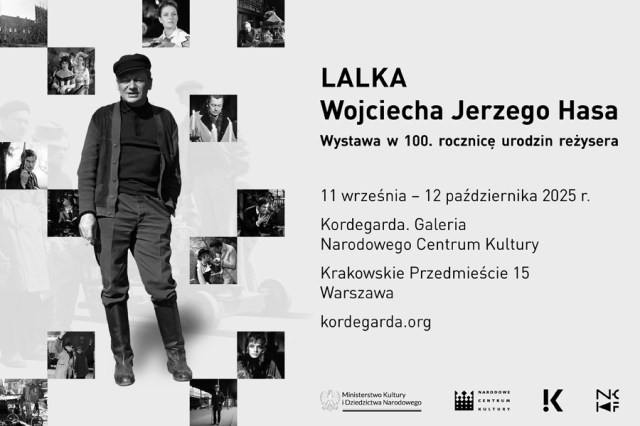
From September 11 to October 12, 2025, visitors can see the exhibition titled "Lalka" (The Doll) at Kordegarda, the Gallery of the National Centre for Culture located at Krakowskie Przedmieście 15/17 in Warsaw. The exhibition is a multidimensional narrative about the film adaptation of Bolesław Prus's novel, directed by Wojciech Jerzy Has. This initiative is part of the official celebrations of the Year of Wojciech Jerzy Has, established by the Senate of the Republic of Poland, and commemorates the centenary of the birth of one of the most important creators in Polish cinema.
The exhibition was organized in cooperation with the National Centre for Film Culture in Łódź. It is an opportunity to rediscover the 1968 film "Lalka," recognized as the largest and most distinctly Warsaw production in the director's portfolio. The film is characterized by its full-scale scenic scope and unforgettable acting performances, including those by Mariusz Dmochowski, Beata Tyszkiewicz, and Tadeusz Fijewski. The project curator is Dr. Rafał Syska (Associate Professor), while the concept for the exhibition space was developed by Prof. Dr. Tomasz Wójcik (Associate Professor) and Marta Gocał. The creators opted for a suggestive, artistic narrative that combines an analysis of the film itself with the broader context of Has's creative work.
The opening of the exhibition, or vernissage, will take place on September 11, 2025, at 18:00. This event is also associated with a ticketed screening of the feature film "Lalka" at Kultura Cinema, scheduled for 20:00 on the same day. Tickets for the screening cost 25 PLN and are available at the cinema box office. The screening is an integral part of the exhibition's inauguration, allowing audiences to encounter the work directly, which is the subject of the presentation.
Exhibition Content
The exhibition at Kordegarda is not just a static display of artifacts but a multimedia experience. A central element consists of large-format projections of fragments of "Lalka," revealing the visual world of the film. In addition to the main theme, the screens also show other productions by Wojciech Jerzy Has featuring the motif of Warsaw, such as "Ulice Brzozowej" (Streets of Brzozowa), "Pożegnania" (Farewells), and "Jak być kochaną" (How to Love). This allows viewers to trace how the director depicted the capital in various periods of his career—from ruins and nostalgia to modernity.
An important part of the exhibition is the unique set designs by Jerzy Skarżyński. As a co-creator of the visual world of "Lalka," Skarżyński played a key role in constructing the image of 19th-century Warsaw. The exhibition allows visitors to follow the process of creating these spaces, showing the contrasts, elegance, and melancholy of that era, as well as the dramatic social inequalities that were a significant motif in Prus's work and its film adaptation.
In addition to projections and set designs, the exhibition presents original documents, photographs, and memorabilia belonging to the director Wojciech Jerzy Has. These materials provide rare information about the creator's life and the behind-the-scenes process of film production. Furthermore, the exhibition includes audiovisual materials that enable a deeper exploration of the film production from both technical and organizational perspectives. This combination of elements ensures that the exhibition is addressed to both cinematography experts and a broad audience interested in cultural and urban history.
The Context of Has's Work
The "Lalka" exhibition is also an opportunity to consider the phenomenon of Wojciech Jerzy Has's work, often described as that of a master of metaphor, narrative, and cinematic imagination. His cinema has influenced creators worldwide, and among the inspirations drawn from his works, sources mention Martin Scorsese, among others. The exhibition at Kordegarda allows viewers to discover how Has built the image of Warsaw from scratch, treating it not only as a backdrop but as a crucial element of the drama and character psychology.
Through the lens of "Lalka" and other films shown, such as "Ulice Brzozowej" and "Jak być kochaną," viewers can observe the evolution of the Warsaw landscape in Has's cinema. The city is depicted there in various aspects: as a space full of social contrasts, a place of nostalgia, or a symbol of modernity. This approach to the subject gives the exhibition both a historical and artistic character, combining the analysis of a specific film with a broader perspective on the director's body of work and his relationship with Poland's capital.
Vernissage and Organization
The event organizer is the National Centre for Culture, and the content partner is the National Centre for Film Culture in Łódź. The exhibition was created in cooperation with many institutions, including the Museum of Cinematography in Łódź, the Documentary and Feature Film Studio in Warsaw, and the Feature Film Studio in Wrocław. This coalition allowed for the collection of rare archival and set design materials, which are now available to the public in Warsaw.
The program of events accompanying the opening includes a vernissage at 18:00 and a film screening at 20:00 at Kultura Cinema. This set of activities aims to create a complete cultural experience in which the exhibition and the film complement each other. For Warsaw residents and city guests, this is a unique opportunity to encounter one of the most important phenomena in Polish cinematography on-site and under original conditions.