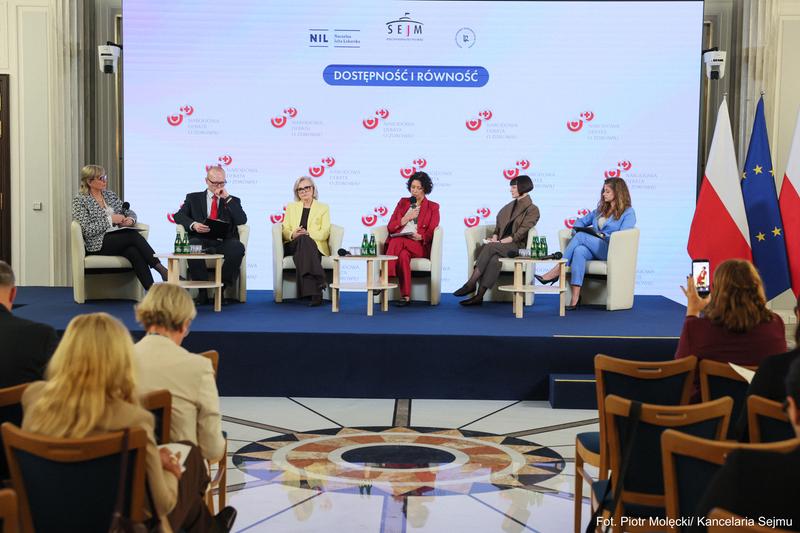
On October 30, 2026, the National Health Debate was held at the seat of the Sejm of the Republic of Poland. The event, initiated by the Sejm, the National Medical Chamber, and the College of Family Physicians, aimed to initiate work on a long-term, cross-party reform of the Polish medical care system. Participants included Marshal of the Sejm Włodzimierz Czarzasty, Deputy Marshal Monika Wielichowska, and President of the National Medical Chamber Łukasz Jankowski, along with a wide range of experts, politicians, and representatives of patient organizations. The main goal of the debate was to indicate paths to improving availability, quality, and prevention in healthcare, excluding current political disputes.
In his inaugural speech, Marshal Czarzasty emphasized that the health of citizens requires thinking in a generational perspective, rather than in terms of successive parliamentary terms. Referring to current data, he stated that the pace of life expectancy extension for Poles, after decades of continuous growth, has clearly weakened. He also pointed to persistent health inequalities that correlate with gender, social status, and place of residence—men live shorter than women, and residents of smaller towns have worse health prospects than those from the largest cities. One of the key issues he highlighted is the shortage of medical staff. The Marshal noted that the number of doctors per 1,000 inhabitants remains below the level necessary to meet needs, and additionally, the aging process of medical personnel is critical—today, one in three nurses and midwives in Poland is of pre-retirement age.
President of the National Medical Chamber Łukasz Jankowski declared that working groups would be established after the conclusion of the debate. Their task would be the cross-party preparation of a long-term system reform. He emphasized that the Sejm was chosen as the venue to ensure the presence of parliamentarians from all sides of the political scene and openness to dialogue. He also stressed that no professional group should be left out, and every participant in the reform process should be heard.
The meeting had a panel format and was divided into four main thematic blocks and a final section. The first panel addressed availability and equality of access to medical services. Experts, including representatives of the Public Defender of Rights and patient organizations, discussed the need for real, not just formal, access to medical help. Key issues turned out to be the coordination of treatment and continuity of care, regardless of the patient's financial situation or place of residence.
The second block was devoted to prevention, prophylaxis, and public health. Participants pointed to the necessity of changing the healthcare model, which currently focuses mainly on treating the consequences of diseases, while investing insufficiently in preventing their occurrence. The discussion involved specialists in family medicine, palliative care, and local government representatives, who emphasized the role of health education from the youngest age.
The third panel discussed health security in the context of infrastructure for crisis events. Participants, including President of the National Pharmacy Council Marek Tomków and professors from Warsaw medical universities, argued that health security should be treated as the foundation of state security. The discussion was moderated by Senator Wojciech Konieczny, Deputy Chairman of the Senate Health Committee. The need for training medical staff in emergency situations was pointed out.
The fourth and final panel was devoted to the finances and economics of the system. Experts, including a professor from the University of Warsaw and the President of the Central Statistical Office, discussed how to finance healthcare so that it is stable and fair. It was emphasized that without a rational financing model, a lasting reform would not be possible. Issues of hospital treatment consolidation and the need for deep care coordination were discussed.
Representatives of patient and professional organizations also spoke during the debate. President of the Federation of Polish Patients Stanisław Maćkowiak pointed out that the current organizational model of the system is exhausting its capabilities and requires modernization. Meanwhile, President of the National Council of Nurses and Midwives Mariola Łodzińska drew attention to the problem of bureaucracy, which consumes staff time that should be spent on direct patient care.
The National Health Debate concluded with an open discussion, in which, among others, Member of Parliament Joanna Wicha and the General Director of the organization “Doctors Without Borders” in Poland participated. The outcome of the meeting was the announcement of the establishment of working groups that will work on specific reform solutions, transcending party divisions. The event was intended to serve as a platform for developing a common stance of various groups for improving the quality and availability of healthcare in Poland for years to come.