Policemen from Pomerania, who are active members of the Gulden Historical Search Association, made a significant discovery on the site of the former Stutthof subcamp, known as the Germanenlager. During their search work, they unearthed a metal object from the ground bearing the scratched personal data of a Finnish prisoner, Aarne Kovali. The find, provisionally referred to by the searchers as a candlestick due to its appearance, although its ultimate function has not been definitively confirmed, became key evidence enabling contact with the missing person's family and the reconstruction of a fragment of his tragic biography.
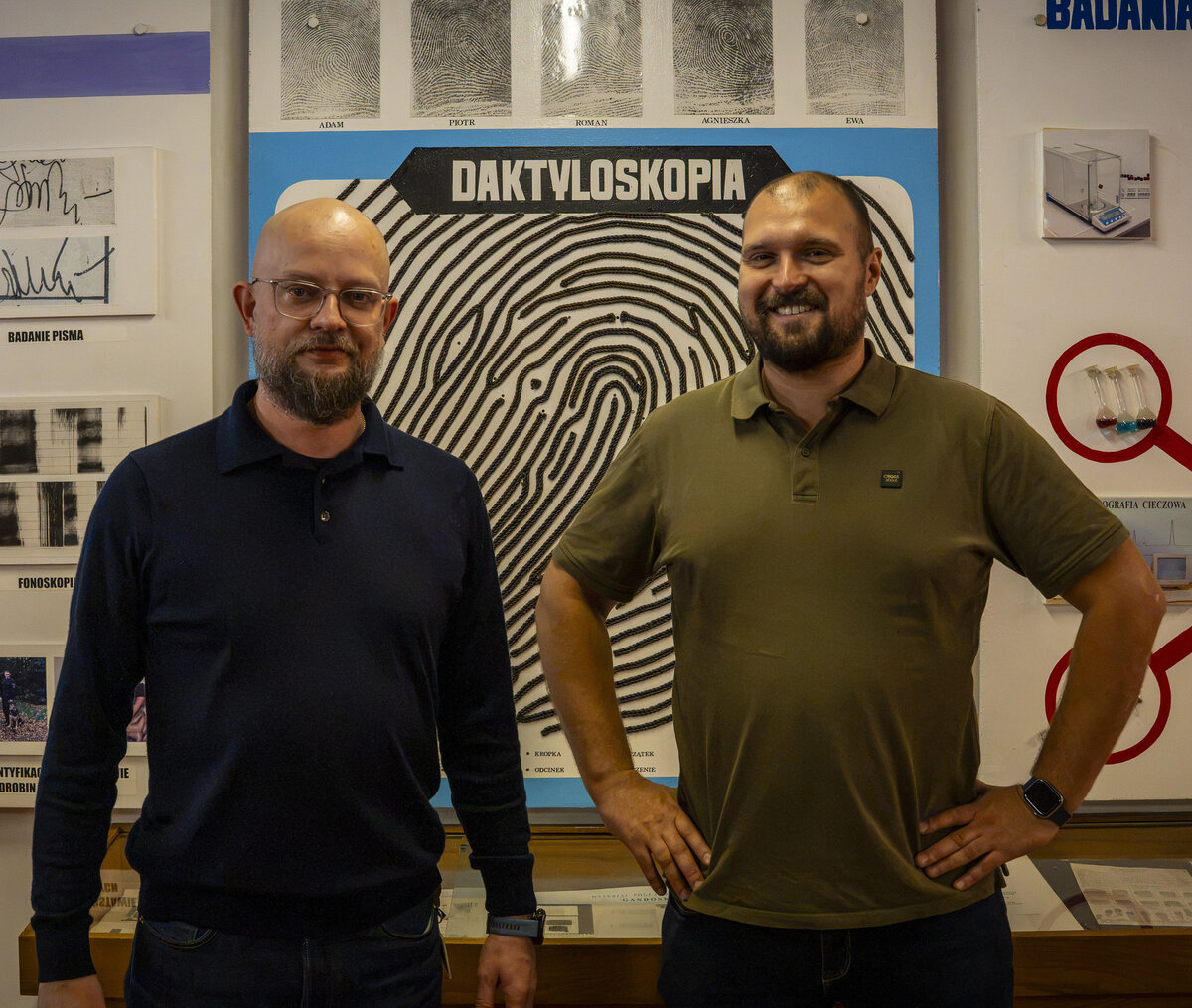
Behind the discovery are, among others, Senior Superintendent Przemysław Andrearczyk, an expert at the Forensic Laboratory of the Pomeranian Provincial Police Headquarters in Gdańsk and a forensic fingerprint expert, and Commissioner Bartłomiej Góra, Deputy Head of the Department of Road Traffic Offenses at the Gdańsk City Police Headquarters. Both officers combine their professional police service with a passion for history, the exploration of historical sites, and the use of modern technology in investigative work.
A Trace in the Soil and the Beginning of the Search
The exploitation of the former Germanenlager subcamp site was initiated in cooperation with the Pomeranian Historical Prospection Society In Terra. It was this organization that, based on academic publications, located the search area and obtained the required formal permits, including a license from the competent provincial conservator of monuments and the consent of the land owner. Members of the Gulden Association joined the work, supporting the team with their experience in using metal detectors.
The work on the site, which once served as part of the Stutthof camp complex, aims not only to recover artifacts but, above all, to investigate the traces of life of people interned in this place. In 1943, 271 Norwegian police officers were held in the Germanenlager, as confirmed by previously found elements such as buttons with the Norwegian coat of arms, Norwegian coins, and canned food. All these finds were transferred to the Stutthof Museum to be analyzed and to enrich historical knowledge about the fate of the prisoners.
Reading Data with Forensic Methods
The key moment of the accidental discoveries occurred when the detector indicated the presence of metal in a place described as an ordinary mown field. While recovering a larger number of items, the searchers came across an element resembling an aluminum tube. Initially, its surface bore only faintly visible, manually scratched marks. Due to their poor legibility, the use of specialized methods was necessary. Senior Superintendent Andrearczyk, utilizing his competencies gained in his work as a forensic expert, took macro photographs that allowed for precise analysis and reading of the inscription.
The photographs revealed the name: Aarne Kovala, and the city of Oulu, located in Finland. The next key element turned out to be the date of January 25, 1945, scratched onto the object. This date has significant historical importance because it coincides with the period when the evacuation of prisoners from the Stutthof camp and the so-called death march began. Reading this information transformed the anonymous metal object into a concrete lead to a human biography.
Biography of the Finnish Sailor
After identifying the data, the searchers, in cooperation with partners from the In Terra association, began to determine the fate of Aarne Kovali. It was confirmed that the man survived the war and left the camp. Genealogical research allowed for the finding of his family. The searchers contacted Liise Kovala, the daughter of the Finnish sailor, who published the book titled “Surviving Stutthof - my fathers memories behind the Death Gate”. This publication became a valuable source of information, allowing for a deeper understanding of the context of the find.
The book helped explain the significance of a second, initially illegible inscription on the object. It turned out that it referred to the power plant where Aarne Kovali's father worked and where the family occupied a service apartment. This means that the scratched data served as a personal address or affiliation mark, left by a young man. Aarne Kovali was a sailor who was interned at a very young age – he was only 16 years old. The found object thus linked a material trace with a specific, human story.
Contact with the family took on an emotional dimension. Aarne Kovali's wife, who is still alive, reacted to the news of the find with great emotion, publishing comments emphasizing the significance of this discovery for relatives. For the searchers, this moment meant that the found artifact ceased to be just a monument and became a bridge between the past and the present, restoring the memory of a person whose fate had remained hidden under the ground for decades.
The Influence of Historical Passion on Criminal Work
The experience gained during the exploration of historical sites has a direct impact on the daily work of both policemen. Commissioner Bartłomiej Góra points out that metal detectors are a useful tool during the inspection of criminal incident scenes. They make it possible to find small objects that might be overlooked during standard procedures. Knowledge of the terrain and the ability to interpret the device's signals, developed in the field, translates into the effectiveness of operational actions.
The officers actively participate in the work of a team dealing with unsolved crimes, referred to as Archive X. One example of the application of these skills was a murder case from about 30 years ago. During the search of the Tri-City area, Senior Superintendent Andrearczyk (the source article also mentions the actions of Senior Superintendent Góra, which may suggest an erroneous name in one of the source fragments, however, according to the facts, Senior Superintendent Andrearczyk is the Forensic Laboratory expert) used a detector to reveal items potentially connected to the crime, including a wedding ring, buttons, and a knife. The secured artifacts were transferred for further laboratory research.
Another significant case was the murder of a gangster in Oliwa in Gdańsk. For three days, intensive searches were conducted both on the shore and in the water, attempting to find the murder weapon and other evidence. Metal detectors were used for this. The actions ended in success: a knife, a telephone, and other items related to the crime were found. This experience proves that detectors can effectively help in finding jewelry items, victim or perpetrator belongings that may have fallen or been trampled into the ground as a result of a struggle.
Education and the Future of Searches
The Gulden Association also develops its activities in the educational sphere. Members organize historical picnics, during which they present found artifacts and tell the history of Pomerania. Special emphasis is placed on contact with youth and the local community, particularly in the Kolbudy commune. During such events, children are shown what searchers do, and they are even allowed to operate a detector, to raise their awareness of alternative forms of activity outside electronic device screens.
Members of the association emphasize that any object carrying information can be treated as a historical document. In the case of the find with Aarne Kovali's inscription, this object became proof of the presence of a specific person in this place. Knowledge of the principles of securing traces, developed during layered terrain examination work, is also crucial in forensics. Incorrect handling of found objects could lead to the destruction of traces that cannot be reconstructed later.
The passion for history and official duties complement each other. Field knowledge helps in better understanding the environment, while police experience allows for a proper assessment of the evidential value of finds. The discovery on the Stutthof subcamp site is evidence that historical exploration can go beyond merely finding an artifact, becoming an act of restoring the memory of specific people and their fates in the context of the Great War.