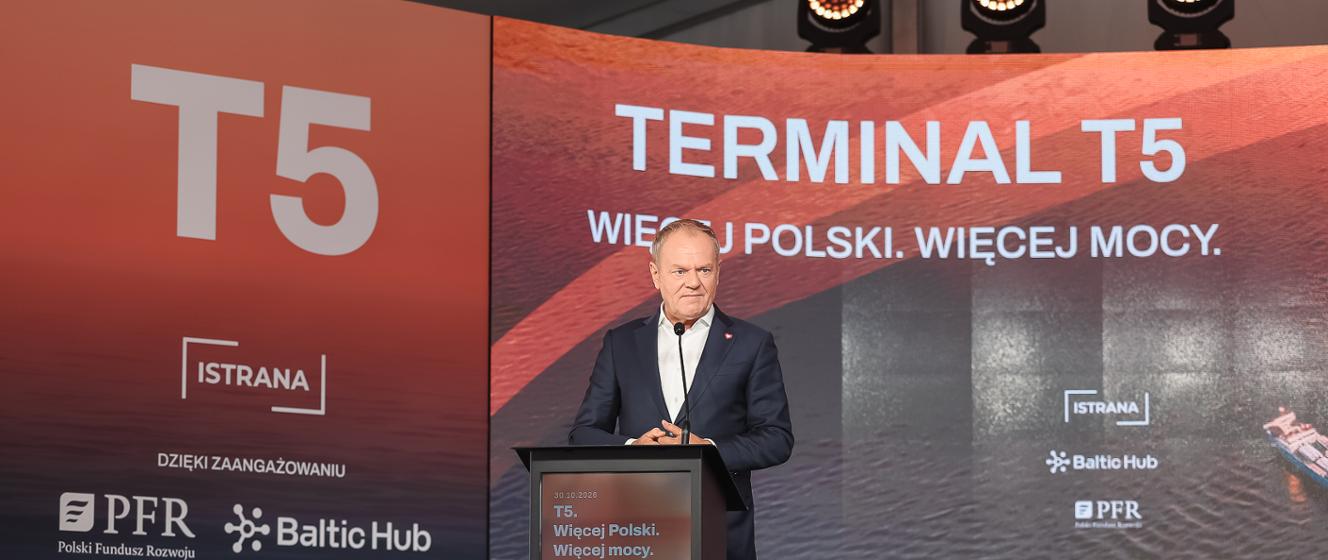
On October 30, 2026, Terminal T5 was officially handed over at the Port of Gdańsk. This strategic infrastructure, valued at PLN 1.2 billion, is of key importance for the development of Polish offshore energy. The terminal will be used to handle the largest offshore wind farm components available in the European market, making it a crucial installation hub for projects in the southern part of the Baltic Sea.
Project Construction and Financing
The realization of the investment was made possible through the involvement of domestic companies and support from EU funds. As indicated by Prime Minister Donald Tusk, over PLN 700 million came from the National Recovery Plan. The construction was undertaken by a consortium of Polish enterprises, with Sopot-based NDI S.A. serving as the general contractor and the Gdansk office of Transprojekt executing the terminal project. The special-purpose company responsible for the investment is Istrana sp. z o.o., belonging to the Polish Development Fund and Baltic Hub. Construction works allowed for the expansion of land by 21 hectares, which, as emphasized during the ceremony, symbolically increased the country's territory.
Connection with the Baltica 2 Wind Farm
Works related to the realization of the Baltica 2 offshore wind farm will be conducted from Terminal T5. Minister of Finance and Economy Andrzej Domański emphasized that over 107 turbines will be transported from Gdansk to their destination. The farm features a capacity of 1.5 GW, and its planned commissioning is scheduled for 2027. Once connected to the grid, the facility is expected to provide electricity for 2.5 million households. Within broader plans for the Baltic Sea, it is possible to install up to 18 GW of wind capacity by 2040. It is worth noting that the first electricity from offshore wind turbines in Poland began flowing on July 10 of this year.
Local Participation in the Supply Chain
A key aspect of the investment is the increased share of Polish enterprises in the offshore sector. The head of the government stressed that Terminal T5 allows for the development of domestic technological competencies and strengthens the supply chain. Citing PKO BP analyses, Minister Wojciech Balczun indicated that increasing the so-called local content by 10 percentage points could translate into a 3.6% increase in GDP and a PLN 30 billion increase in state revenues. Such growth is significant not only economically but also for the country's energy security and independence.
Macroeconomic Context
During the opening ceremony, issues of price stability in the country were also raised. Prime Minister Tusk referred to inflation data, which stood at 4.1% in September and fell to 3.5% in October. This decrease was attributed, among other things, to the action of the CPN package and the law on the tax on extraordinary profits of fuel corporations, which limit energy costs and protect household budgets.