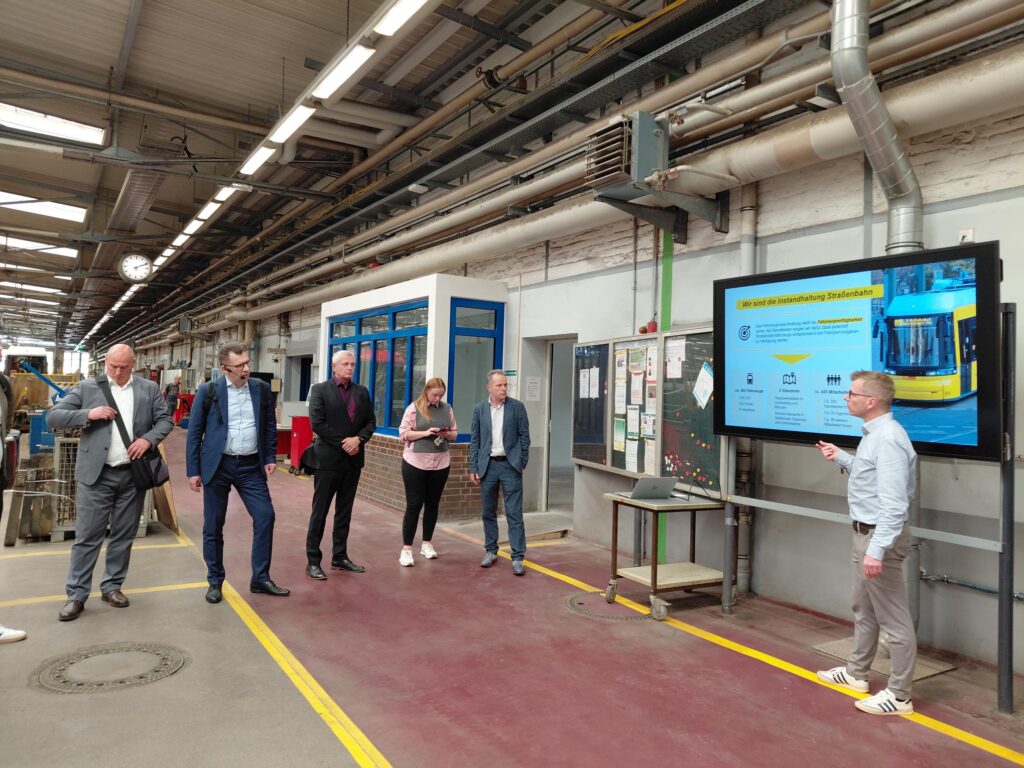
During the 36th seminar of the International Administrative Cooperation, representatives of Warsaw and Berlin discussed the challenges of modern urban mobility, with a particular emphasis on the development of the tram network. The meeting aimed to compare different models of public transport planning and financing in both metropolises, which operate under different organizational and historical conditions.
The Warsaw delegation included staff from the Office of the President of the City of Warsaw, Warsaw Trams, and the Urban Transport Authority. The discussions were led by Maciej Fijałkowski, Secretary of the City of Warsaw. Seminar participants had the opportunity not only to talk with the Berlin administration responsible for transport but also to inspect local infrastructure. The study tour program included tram routes and the Lichtenberg depot, where the Polish guests met with experts from Berlin's transport operator BVG. The discussion covered key aspects of city management, such as tram network planning concepts, stop design, and line routing.
A significant part of the program was the presentation of Warsaw's experience in maintaining safety in public transport. Artur Zając, Director of the Transport Division of ZTM, presented the capital's integrated safety system. According to the information presented, Warsaw's solutions go beyond the classic protection of passengers and infrastructure, covering cybersecurity, data protection, crisis readiness, and the operational resilience of the entire system.
The speaker described the cooperation between ZTM and transport operators, the police, the city guard, the fire brigade, and crisis management services. Such institutional coordination aims to ensure efficient response to emergency situations. Participants also learned about the scope of the surveillance system, which covers the metropolis in a multimodal way – including the metro, buses, trams, and transfer hubs. The ZTM Operations Center plays a key role in day-to-day supervision, overseeing the functioning of public transport around the clock.
Particular attention was paid to issues related to cybersecurity and the preparation of IT infrastructure for the event of a failure. Methods for maintaining the continuity of the transport system's operation in scenarios of communication disruptions or technical faults were discussed. As Artur Zając points out, observing Berlin's solutions from a different perspective allows for reflection on the transfer of selected concepts to Warsaw, which may influence the further development of public transport in the capital.