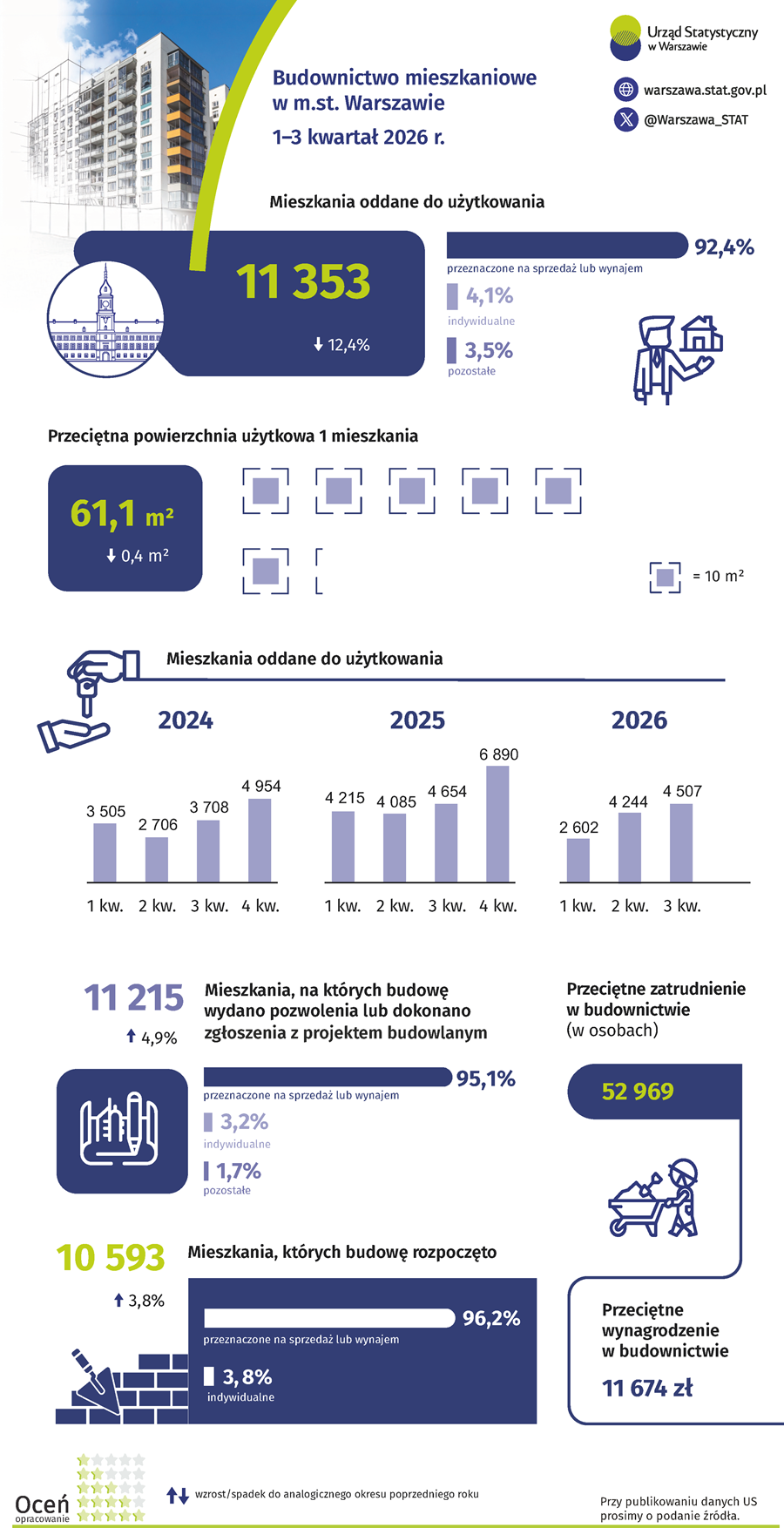
Warsaw recorded a significant increase in residential construction activity in the first three quarters of 2026. According to the Statistical Office, a total of 11,353 units were handed over for use, representing an 11.2% increase compared to the same period in the previous year. The dynamic development of the residential market is also evident at the stage of obtaining investment documents and commencing construction work, although the pace of these processes is no longer as significantly higher as in the case of the delivery of completed units.
Commissioning and Initiation of Investments
The most important indicator for the housing market is the number of units handed over for use, which exceeded 11,000 units in the analyzed period. The high growth rate of over 11% indicates that residents of the capital had access to a larger pool of new apartments than in the previous year.
The processes of planning and starting new investments also show an upward trend, albeit at a lower pace. In Q1–Q3 2026, building permits were issued or notifications were filed for 11,215 apartments, meaning a year-on-year increase of 4.1%. Meanwhile, actual construction started for 10,593 units, which is 3.8% more than in the same period of 2025. Differences between the number of permits issued, notifications of investments, and construction started may result from time lags in administrative processes and differences in the scale of the investments.
Investment Structure and Apartment Size
An analysis of the structure of residential construction in Warsaw shows the strong dominance of the individual sector. In the case of apartments intended for sale or lease that were handed over for use in the first three quarters of 2026, 96.2% were from individual construction. This means that the vast majority of new commercial units in the capital were built at the initiative of private investors or developers operating under the individual construction model, rather than large-scale, institutional development.
A valuable characteristic of the observed trend is also the increase in the average useful area of apartments. In Q1–Q3 2026, this average was 61.1 m², representing a 0.4 m² increase compared to the previous year. The small but steady increase in square footage suggests that demand for larger units is growing on the Warsaw market, and developers and individual investors are adjusting their projects to the changing needs of buyers who prefer more spacious apartments over compact studios.
Construction Labor Market
The indicated changes in apartment supply and unit parameters are accompanied by specific phenomena in the construction sector labor market. The average wage in construction in Warsaw reached 11,674 PLN in Q3 2026. This is an important cost indicator for investors and developers who must calculate labor costs when pricing new apartments.
However, despite the increase in the number of apartments delivered, employment in the construction industry in the capital shows a downward trend. Average employment in construction in Q3 2026 was 4,244 people, indicating a 3.5% decrease compared to Q3 2025. The paradox of a decreasing number of workers alongside an increase in the number of delivered units may indicate an increase in labor productivity, the application of new construction technologies, a change in the structure of employment (e.g., an increase in the share of contract work), or that the increase in the number of apartments delivered for use does not correlate linearly with the number of workers involved in construction processes within Warsaw at a given time (e.g., outsourcing work to subcontractors from outside the capital).