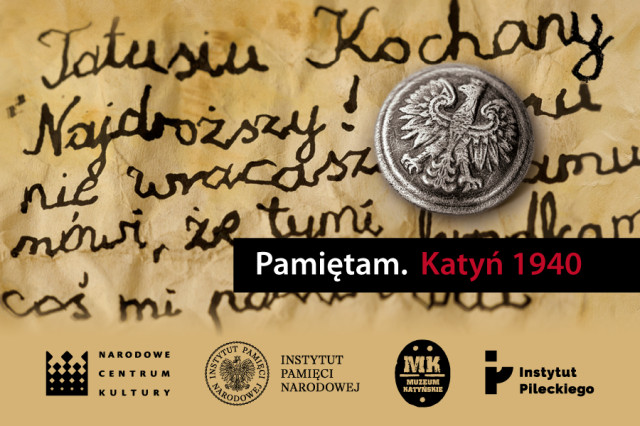
In the spring of 1940, over 22,000 Polish citizens were murdered by the decision of the Soviet authorities. Among the victims of this crime were professional officers, police officers, and reserve officers, as well as doctors, teachers, lawyers, and scientists. With the approaching 86th anniversary of these events, the next edition of the socio-educational campaign "I Remember. Katyn 1940" is beginning, aiming to commemorate the victims and preserve authentic historical knowledge.
The main symbol of the project is a pin in the form of a replica of a military uniform button. This artifact refers to Zbigniew Herbert's poem "Buttons" and is intended to be a silent witness to the crime, while simultaneously serving as a sign of resistance against the falsification of history. Initiated by the National Centre for Culture in 2007, the campaign continues its activities in a special geopolitical context. Rafał Kościański, PhD, Press Spokesperson of the Institute of National Remembrance (IPN), draws attention to the return of Russian propaganda to the narrative of German responsibility for Katyn. A symbol of these trends is, among other things, the removal in 2025 by the Russian Federation authorities of Polish military symbols, such as the Order of Military Merit (Order Virtuti Militari) and the Cross of the September Campaign, from the cemeteries in Miednoye and Katyn.
Activities in Warsaw and Around the World
On April 11–13, as part of the "Pin the Button of Memory" action, pins will be distributed at designated locations across the country and abroad. In Warsaw, the main locations are the Katyn Museum, the Kordegarda Gallery at Krakowskie Przedmieście 15, and the IPN branches and delegations. The activities also have an international character – the buttons will be delivered, among other places, to the Pilecki Institute in Berlin and New York. Institutions and associations wishing to conduct local distribution actions can apply for materials until March 27, 2026.
On April 12, anniversary ceremonies will take place in Warsaw at the Katyn Museum with the participation of the Victims' Families. On the same day, the Katyn Shadow March, organized by the "Zgrupowanie Radosław" Historical Group Association, will march through the streets of the capital. The following day, on April 13, Katyn buttons will be available for collection at the Kordegarda Gallery; the event will accompany the exhibition "Meridian 21," which opened the previous day and is inspired by the work of Józef Czapski, a prisoner of the Starobielsk camp who survived and fought for the truth about the crime until the end of his life.
Education and Event Calendar
The campaign is accompanied by a rich educational program. In March and April, workshops titled "The Katyn Investigation" are being held at the IPN Regional Bureaus of National Education in many Polish cities. In Warsaw, a week of educational classes is also planned at the Dom Bez Kantów, aimed at students of secondary schools and seventh-grade primary school classes. An important point on the calendar is April 15, when a historical debate dedicated to the Katyn lie will be held at the Central Stopover of History (ul. Marszałkowska 107).
The organizers, including Karol Madaj from the Pilecki Institute, emphasize that the goal of the action is to remind people that behind each of the 22,000 victims lies an individual tragedy and a specific human story. Along with the pins, badges with the silhouettes of twenty selected victims are distributed, whose fates are recalled by the campaign on social media. The project also includes an educational package for schools, containing, among other things, the mini-series "Sztafeta" and the audiovisual material "I Saw It With My Own Eyes" featuring an account by Józef Mackiewicz.
In the face of limited access to places of memory, such as the forests in Katyn or Miednoye, the initiators point to the importance of symbolic gestures and building an aware citizen community that cares for historical truth regardless of current politics.