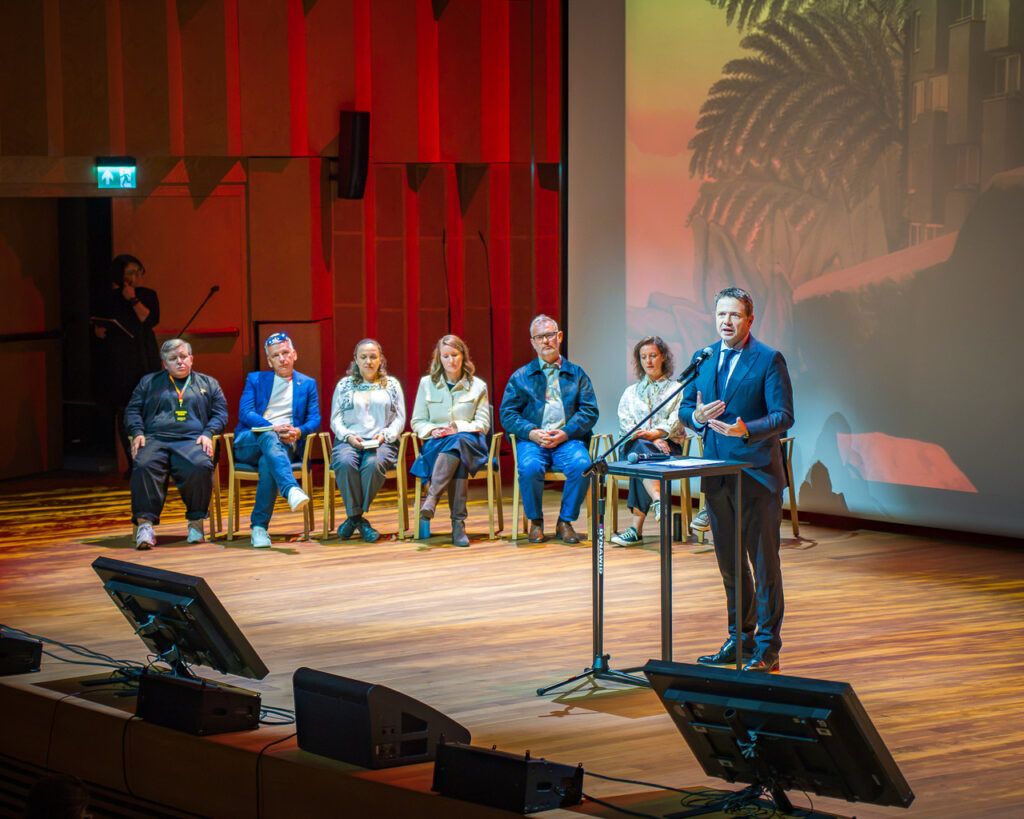
The Greenery Management Office of the Capital City of Warsaw organized a conference titled “Symbiocen. The Green Future of Cities,” dedicated to urban development strategies resilient to climate change. The event gathered representatives of city departments, experts, and designers who discussed methods for adapting urban space to new environmental challenges. The Warsaw Public Transport Authority (ZTM) was also among the participants, sharing experiences from the implementation of specific green infrastructure investments.
Presentation of the EKO P+R Połczyńska Project
A key element of ZTM's participation in the conference was a presentation during the panel discussion “From Pioneering Actions to Standard.” Maciej Wicik, Director of the Investment Division at the Warsaw Public Transport Authority, presented the EKO P+R Połczyńska project there. This investment directly concerns the adaptation of urbanized areas to climate change, aligning with the broader goals of the city's ecological policy.
During the presentation, Director Wicik referred to difficulties that arose during the implementation phase. As he emphasized, despite existing challenges, the authority is staying the course, and the continuation of the project is possible thanks to the determination of the team. Wicik pointed out that determination is a key factor allowing for the further development of the initiative, even in the face of unforeseen complications.
Financing and Exchange of Experience
The EKO P+R Połczyńska project benefits from co-financing from the National Fund for Environmental Protection and Water Management. These funds come from Action FENX.01.02 “Adaptation of Urbanized Areas to Climate Change,” which is part of Priority FENX.01 “Support for the Energy and Environment Sector.” The entire project is financed by the Cohesion Fund under the European Funds for Infrastructure, Climate, and Environment 2021–2027 program.
The “Symbiocen. The Green Future of Cities” conference also served as a platform for exchanging knowledge between various entities involved in the development of Warsaw. Participants discussed the need to identify solutions that initially have a pilot character and can then be implemented as a standard for the entire city. The presentation of the EKO P+R Połczyńska project was part of a broader debate on how to transition from individual, pioneering actions to unified urban standards.